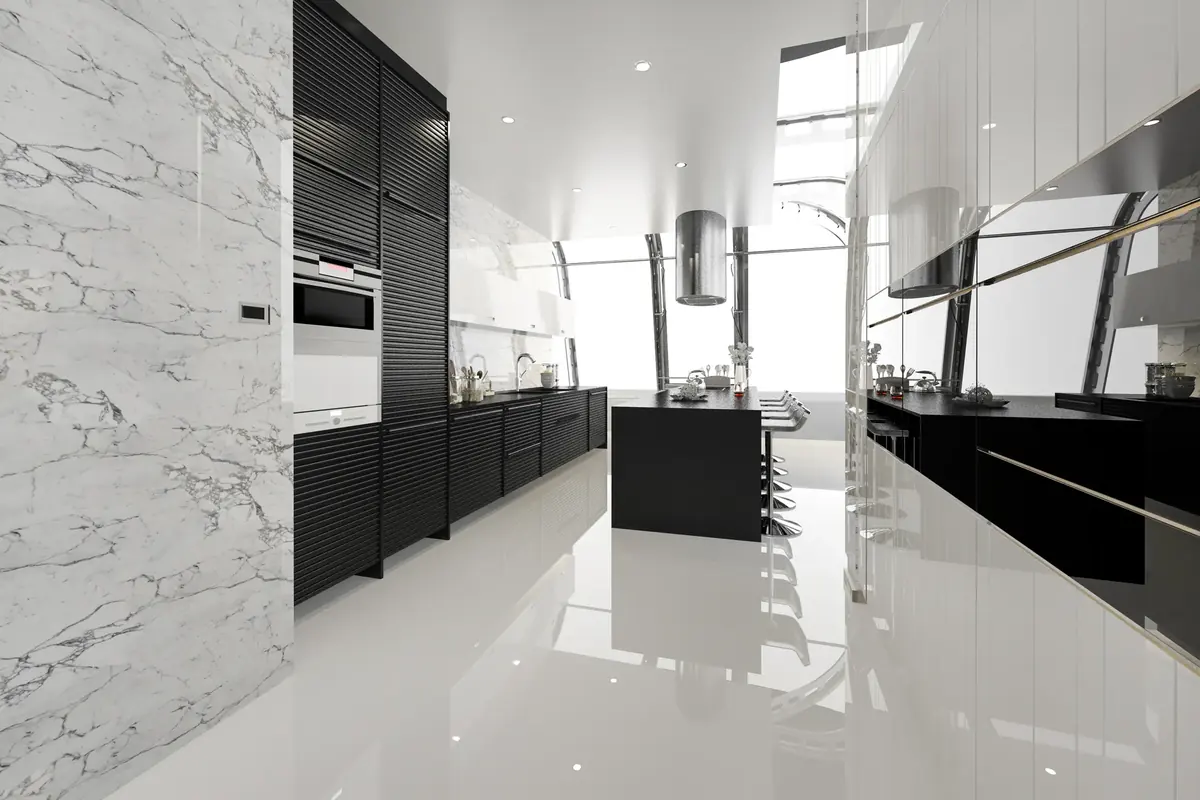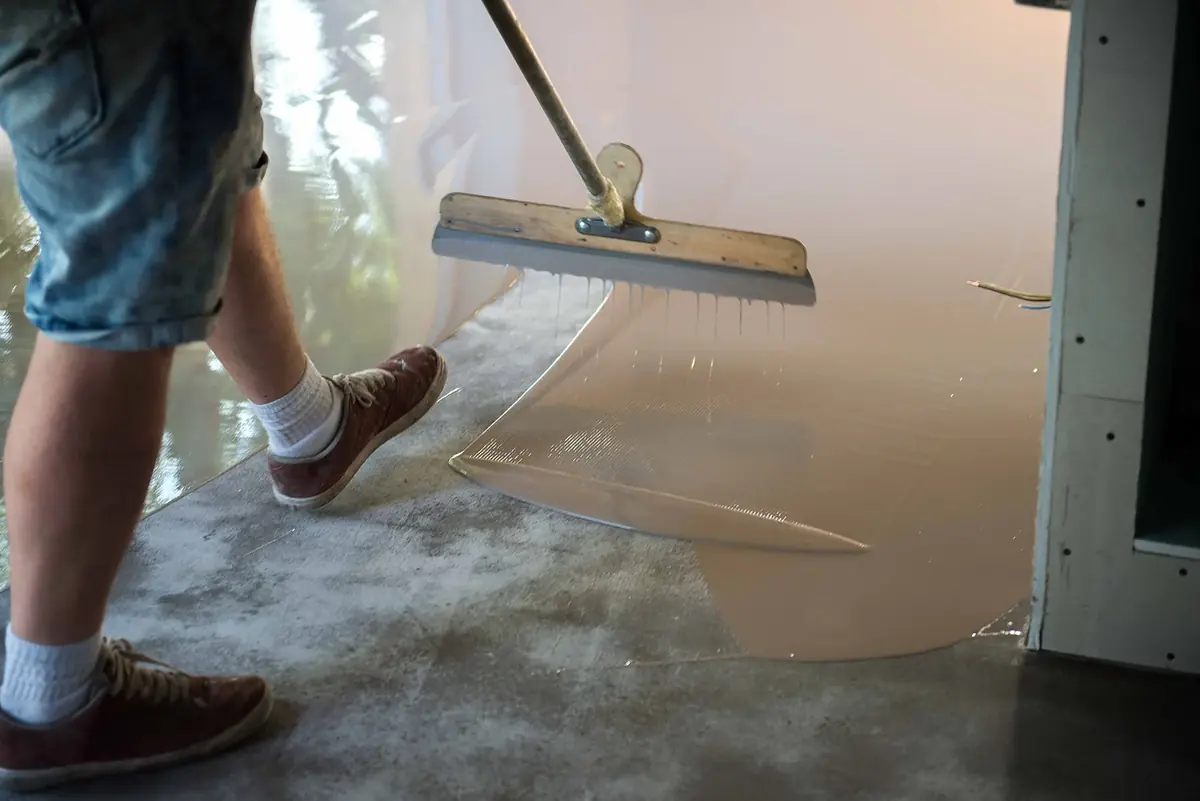
Metallic epoxy is where floor coating becomes craft. The materials are straightforward: a clear epoxy carrying very fine reflective pigment. What makes the floor is the work done while that epoxy is wet. Installers spread it, roll it, brush it, mist it and sometimes blow air across it, and the pigment responds by settling into patterns that resemble marble, agate, cloud or moving water.
People choose metallic floors because they want something no one else has. That's exactly what they get. This page explains how these floors are built, where they make sense, and what owning one is like.
What you're actually seeing
Metallic pigments are tiny flat particles, usually mica coated with metal oxides, that act like microscopic mirrors. When they lie flat, they reflect light strongly and the floor looks bright. When they tilt or cluster, they reflect less and the area looks darker. As the epoxy is worked, those particles shift into areas of light and shadow, which is what produces depth.
Layering adds more. A second color poured into the first creates contrast. A clear or tinted base under the metallic layer changes how bright the overall floor reads. And because the epoxy continues to flow briefly after manipulation, the pattern softens as it cures.
Picking a direction
Rather than choosing a product number, most clients start with a mood:
- Quiet luxury: pearl, champagne, soft silver, one or two colors, gentle movement.
- Stone and marble: white or light gray base with charcoal or gold veining.
- Desert warmth: copper, bronze, caramel and sand, which work beautifully with Phoenix architecture.
- Bold and moody: charcoal, black, deep blue or teal with silver highlights.
- Brand color: retail or office floors keyed to a company palette.
From there we narrow the palette with sample boards and photos of floors in similar colors.
Where metallic floors make sense, and where they don't
| Space | Fit | Why |
|---|---|---|
| Great rooms and living areas | Excellent | Natural light shows off the depth |
| Entries and hallways | Excellent | High-impact first impression |
| Kitchens and bars | Very good | Seamless and easy to clean; consider satin and grit |
| Boutiques, salons and offices | Very good | Distinctive, brandable surface |
| Show and collector garages | Good | Spectacular, but needs gentle use and regular dust removal |
| Busy daily-driver garages | Limited | Smooth surface shows grit, scratches and tire marks |
| Uncovered patios | Not recommended | Epoxy yellows and chalks in sun |
For busy garages, a flake system usually ages better. For patios, see patio and concrete coatings.
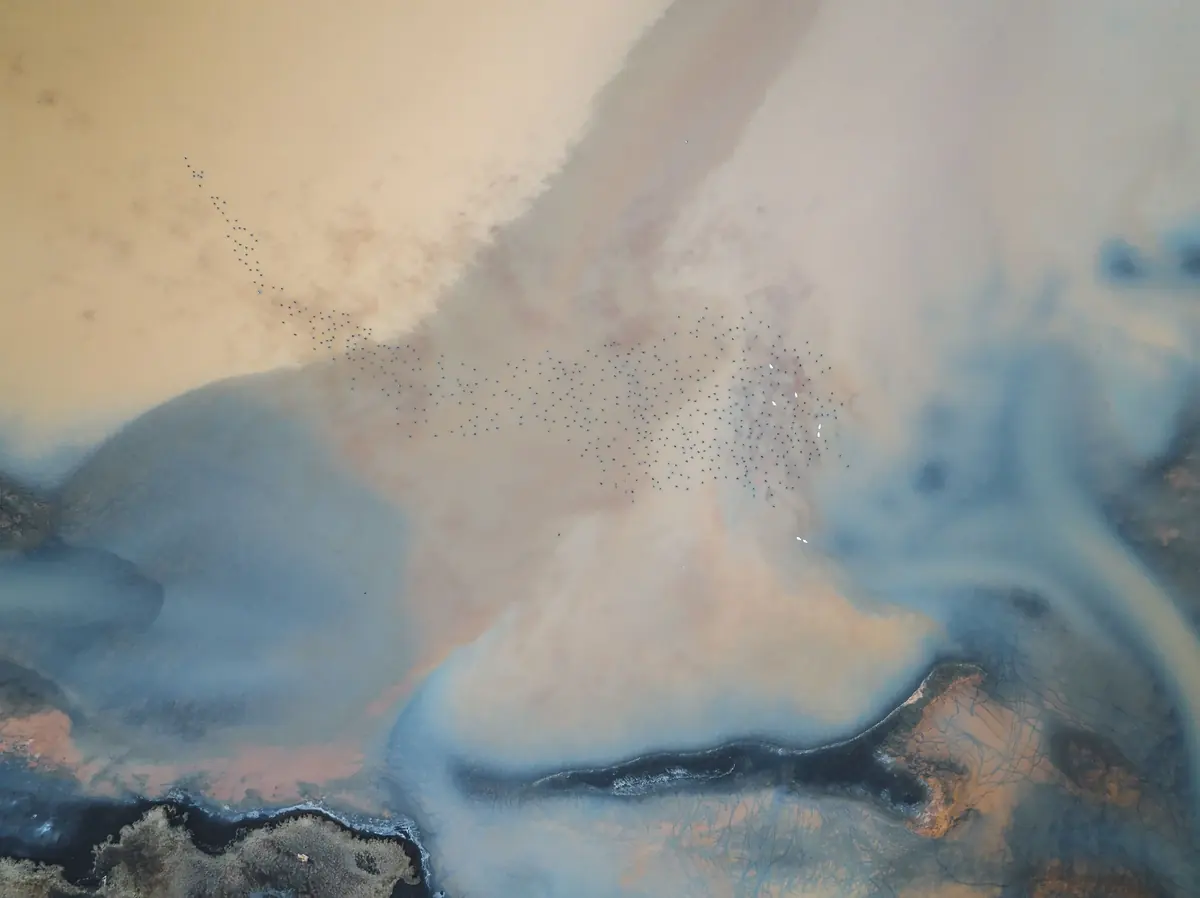
Our metallic installation sequence
Preparing a flat canvas
Metallic epoxy finds every low spot and pools there, so the slab must be flat. We grind thoroughly, fill every crack and divot, and often apply a skim or self-leveling layer. Moisture testing is essential because blisters in a glossy metallic floor are impossible to hide.
Priming and base color
A primer seals the concrete to prevent air from rising out of the slab and forming bubbles in the decorative layer. A tinted base follows; it sets the background tone and affects how bright the finished floor reads.
The metallic pour
This is the step that defines the floor, and it happens all at once. The metallic epoxy is mixed in measured batches, poured in ribbons and spread. Then the crew works it with rollers, brushes and other tools to create the pattern. In larger rooms, several installers work in a coordinated line so wet edges merge without visible seams. Once the pour starts, it continues until the room is complete.
The protective topcoat
Epoxy is a beautiful decorative medium but not the hardest wear surface, and it can yellow over time in UV. We finish every metallic floor with a clear aliphatic urethane or polyaspartic topcoat in your chosen sheen, with optional clear grit in kitchens, baths and entries.
Curing
Metallic epoxy cures more slowly than fast-cure garage systems. Expect light foot traffic after roughly a day and furniture after several days, with exact times in your written schedule.
Why metallic floors need an experienced crew
Metallic floors leave no room for hesitation. Working time is limited, especially when it's warm. Mixing must be precise so every batch looks the same. Lap marks appear if a wet edge is lost. Dust, hair and insects are permanently visible. And the artistic part, knowing how hard to work a pattern so it settles into what the client wanted, only comes from repetition.
There is also planning: where the pour starts and ends, how a hallway connects to a great room, and how the lighting will reveal the finish after the crew leaves.
Phoenix conditions for metallic work
Heat cuts working time
Metallic epoxy needs to stay workable long enough to manipulate. In summer, we cool the space, store material out of the heat and start early. Interior pours go best with the home's air conditioning running steadily.
Sun through glass
Large windows can put direct sun on part of an interior floor every afternoon. The UV-stable topcoat protects the metallic layer, and window treatments help preserve any floor.
Dust control
A dusty gust through an open door can ruin a glossy finish. We seal the room, keep exterior doors closed and manage traffic in and out during the pour.
What it costs, and why
Metallic floors cost more than flake or solid color because of labor and skill. The main drivers are how much leveling the slab needs, the room layout, the number of colors and layers, the topcoat type and whether old flooring must be removed. We itemize these so the price makes sense.
Living with a metallic floor
- Put doormats at every exterior entry; grit is the main enemy of glossy surfaces.
- Dust mop with microfiber often, and damp mop with a neutral cleaner.
- Use felt pads on all furniture.
- Consider satin sheen in high-traffic areas; it hides fine scratches.
- Refresh the topcoat in traffic lanes when it dulls, without touching the metallic layer below.
Lighting changes everything
Metallic floors respond to light more than any other finish. Under strong natural light, the reflective pigment reads bright and three-dimensional. Under a few dim bulbs, the same floor can look flat. When we plan a metallic floor, we ask about windows, fixtures and how the room is used at night. Recessed LEDs, linear fixtures and warm accent lighting all bring out depth. If you're remodeling, it's worth thinking about lighting and the floor together rather than separately.
Metallic floors in businesses
Boutiques, salons, tasting rooms, offices and showrooms use metallic floors to create a memorable space without the cost and maintenance of natural stone. A few commercial considerations matter: choose a satin or textured topcoat in high-traffic paths, place walk-off mats at entries to catch grit, and plan the pour around business hours since metallic layers cure more slowly than fast-cure systems. Brand colors can be matched closely in the pigment palette.
Misconceptions about metallic epoxy
"It's just paint with glitter." Metallic floors are a multi-layer resin system with real film thickness, not a thin paint.
"It's too fragile for daily life." With a hard protective topcoat and normal care, metallic floors handle household and retail traffic well. They do show scratches more than flake, so care habits matter.
"Every floor looks like a lava lamp." Metallic can be subtle. Single-color, low-contrast floors with gentle movement are among our most requested.
How long a metallic project takes
Plan for several days on site for a typical interior metallic floor. Demolition and grinding come first, then repairs and leveling, then primer and base color, then the metallic pour, then the protective topcoat. Each layer needs its own cure time before the next, and the metallic layer itself is slow to cure compared with fast garage systems. We give you a day-by-day plan so you can arrange furniture storage and household routines.
Preparing your home for a metallic pour
Because metallic floors are glossy and slow to cure, the environment matters. Before the pour day we ask that rooms be emptied, ceiling fans be turned off, pets be kept away from the area and nobody walks through until we give the all-clear. Air conditioning should stay on and steady. Small steps like these keep dust, pet hair and air movement from marking the finish while it's at its most vulnerable.
Metallic epoxy floors
Can I know exactly how it will look?
Not exactly, and that's part of the appeal. Sample boards, photos and a clear conversation about movement and contrast set expectations closely.
Are metallic floors slippery?
Gloss surfaces can be slick when wet. We can add clear grit to the topcoat or choose satin for kitchens, baths and entries.
Can metallic go on walls or countertops?
The same family of materials is used on countertops and some vertical surfaces, but our focus is floors. We're happy to talk about matching accents.
Can you add to an existing metallic floor later?
Colors can be matched; patterns can't. For additions, we usually design a deliberate transition, such as a border or threshold.
How long will it last?
Indoors, with a good topcoat and reasonable care, a metallic floor can look great for many years, with occasional topcoat refreshes in busy areas.